
PART I - Charlottesville And Albemarle County
PART II - Strengths and weaknesses
By Rey Barry
Rejoice in the opinions you agree with;
curse the rest.
Last tweaked 6/25/2019
|
It's an island of civilized awareness at the top of the South. People fed up with a declining world find living in Charlottesville a reasonable revenge. Charlottesville is a romantic city in ways different from the magnolia and Spanish moss romance of the deep South. That's historical romance. Charlottesville is for today's romantics - part tradition, part restless innovation, part well earned pride.
They lost big. With their land devastated, their economy destroyed, and their culture in shambles, the able and ambitious left to seek life's rewards in the North and West. That created a devastating brain drain across the south that lasted 100 years. Later jim crow laws infested the region, rendering the non-white South insufferable to all but the servile, so the able and ambitious African-Americans also left. What of those who remained?
To a native Southerner there's no such thing as the past. Each Southerner is a living part of Dixie history. Southern heritage is always just below the surface. The Northern Invasion is no longer an open wound but they all bear a scar. Not that we don't have visitors who came to spend the night and never left. Some spent the rest of their lives here, served as mayors and legislators, even our governor. But when they die, a dixie undertaker might call to ask what state they call home so he can ship the body.
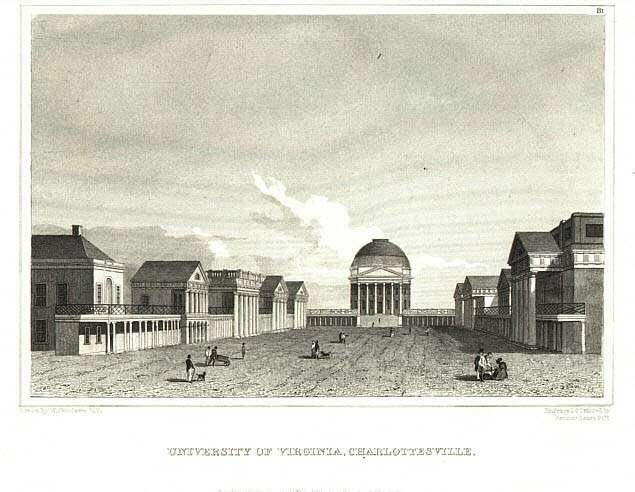
In 1819 Jefferson founded The University of Virginia here which has influenced our town ever since. Students (with many lapses) and faculty (with many lapses) compensated for the local brain drain. Jefferson imported artisans from Europe to build his structures, and faculty to staff his university. Many of their descendants are still here, with some artisans still practicing the family trade. Thanks to the University and an enlightened post-WW II president named Colgate Darden, by the 1950s the brain drain here was in reverse even as the rest of the South was still leaking. Charlottesville's unconventional ground attracted and nurtured exotic outsiders who do not always transplant successfully. For example, junior off-spring of America's industrial midwest wealth settled in the county farmlands around our city. It is those - the Jefferson imports and wide-ranging transplants - that make Charlottesville and Albemarle County a delightful mini-civilization. Forbes Magazine in September, 2011, ranked the area No. 13 on a list of the top 20 US areas for millionaires. May well rank higher now. America's wealthy heirs and heiresses are not equal. Many controllers of great industries dwell in rust belt states. Their most able sons live nearby. What of the daughters and the less able sons, rich, educated, but unwelcome in corporate board room? What of the impotent heirs to generation-skipping trusts? Albemarle County welcomes them. They ride to the hounds, insatiably drink, feel sorry for themselves, and embrace a culture dominated by the horse. It's the grandest thing that can happen to an area. Why? Think chain stores and national corporations. Chain stores, national businesses, provide a wonderful addition to the variety and range of shopping in any town. And they provide jobs, local advertising revenue, and sales taxes. The downside is that after the local bills are paid, they ship the profits out of state to the home office. The chains suck up local money and spend it expanding elsewhere and distributing some to the founders and backers. This is money snatched up out of the home towns that generated it. But there's an upside. Those who reap those profits spend some where they live, and a lopsided number live here. So here national business is not all outflow. Most of our wealthy didn't take it from us; they took it from other people and brought it here. One example: the late newspaper magnate John Knight married into the horsey set here, yet without even including the Knight-Ridder chain of newspapers, the owners of more than 125 other US daily papers lived in Albemarle County in recent years. We can rely on this imported wealth for local investment, political and charitable contributions, entertainment, social life, etc. Forbes ranks the area as No.3 of the top 10 US areas for charitable giving. We have 33 banks here as of 2019 with money to lend for local development. They average 4 branches each, so there are 132 banking offices in and near Charlottesville. Staggering. Attracted by mint juleps served in monogrammed silver, celebs have been drifting in for generations. Writers, actors, painters, and all manner of the accomplished came to this land of congeniality. Those who left pretense behind found a welcome. Aside from passionate southerners, few today care about history. Mentioning celebs like local product S. S. Van Dine, the seminal detective story writer who fled to New York to create Philo Vance (and never came back,) or Southern intellectual James Branch Cabell who succeeded in New York without severing Southern ties, or composers Randall Thompson and John Powell, won't bestir us today. But mention should be made of former local color Oskar JWF Hansen, a noted 20th century sculptor and a monumental character. Those of us who met Hansen never forgot him. He lived the full lives of three men and then some. Millions see his great sculptures at Hoover Dam, Washington, and Yorktown. Here's a brief, borrowed, bio. The first woman to take a seat in Britain's Parliament was Nancy Witcher Langhorne of Greenwood in Albemarle County before she was Lady Astor. [I met her at a party in Maine shortly before her death.] Current celeb memories perhaps begin with William Faulkner who came here in retirement to join his family and ride-to-hound.
Faulkner's grandsons founded the first local brew pub. It was down the street from Charlottesville's most unusual restaurant, John Tuck's legendary Gaslight. Restaurants define local ambience and are defined by it. The Gaslight couldn't have been what it was anywhere else. If you were ever there, my history will bring back memories.
An icon of the 60s, Richard Farina, wrote his book "Been down so long it looks like up to me" in a house on University circle a few doors from where a legendary "Anastasia" claimant would live later in the decade. Farina and Carolyn Hester, the sweetest of folk singers, lived here in 1960-61. Later Dick traded her in for Joan Baez's sister, Mimi. While they were here, Hester recorded her title album, perhaps her best. Writer Rita Mae Brown came here as tennis great Martina Navratilova's companion. The tennis star moved on (athletes tend to) but Rita stayed to ride-to-hound, telling us, as does everyone, "If the world were a logical place, men would ride side-saddle." John Grisham and John Casey write their novels here. Grisham is a generous civic benefactor and active Democrat. Former poet laureate Rita Dove writes her poems here and often lends her presence to projects. The late Mary Lee Settle's wonderful books were penned here for years. Grand Master short story writer Peter Taylor bought Faulkner's house and closed out his teaching and writing career here, trying to teach his craft to scores of us. When Ian Fleming died, his publisher chose John Gardner to continue writing James Bond novels. Gardner, an Englishman, moved here. When someone was commissioned to write a sequel to Gone With The Wind, it was Alexandra Ripley from here. (Did anyone read "Scarlett?") The great New York Herald Tribune TV critic John Crosby retired here. He defined forever the problems facing a TV critic when he said in 1955: "He is forced to be literate about the illiterate, witty about the witless and coherent about the incoherent." Noted JFK assassination researcher Mark Lane retired here to join his sister. Sports celeb Howie Long calls this home, as do Mr. and Mrs. Jack Fisk (Sissy Spacek) and WKRP's Venus Flytrap, Tim Reid. Entertainers are known to lend support to local charities when asked. Caveat: if you recognize a famous face on the street or in the supermarket try not to stare and do not ask for an autograph. Ever. Mind your own business if you want respect.
For as long she could stand Sam Shepard pinching every waitress, Jessica Lange lived here with him. Alan Alda had a place nearby. When the late John Kluge's broadcast properties were sold to make the Fox network, John brought his 7 billion to Albemarle and the area ramped up to resemble Palm Springs East. Grand parties, celeb helicopters, heights of vacuity Faulkner never imagined until he read F. Scott Fitzgerald. With no ostentation whatever, billionaire mensch Edgar Bronfman moved in to be near family and raise bison. Very different style. Kluge favored a Volvo limo and had two of them; Bronfman drove beat-up wheels, around here at least. Both were wonderfully generous to the University. Multi-multi-millionaire widows move here for the company. The Cities Service widow lived and invested here, as did the Schenley widow. There's an heiress to downtown Palm Beach with a husband named Merlin. When all her glitter turned to dross, the leading claimant to be Anastasia, Anna Anderson, moved here to live out her days. She had a childhood friend already here, Gleb Botkin, the son of the court physician to Russia's last czar. Anna caught a husband here, local historian Jack Manahan. A grand duchess who turned the Cinderella story upside down deserves a page to herself and we give her one here. We were friends, so these are personal memories. "The Dave" is in Charlottesville but musicians thrived here long before Dave Matthews. All manner of noted musicians: classical, folk, pop, bluegrass, came and set a spell. It's often the University that attracts them. My UVa classmate the folklorist Paul Clayton (Worthington) broke new ground by getting a Masters degree at the University collecting Appalachian folk music. During the dance band era the University was a mecca for big names playing at the three dance weekends: Openings, Mid-Winters, and Easters. The oldest and grandest of them, Easters, brought in major entertainment beginning in 1915. 50 years later I published the list of the first half-century of Easters entertainment.
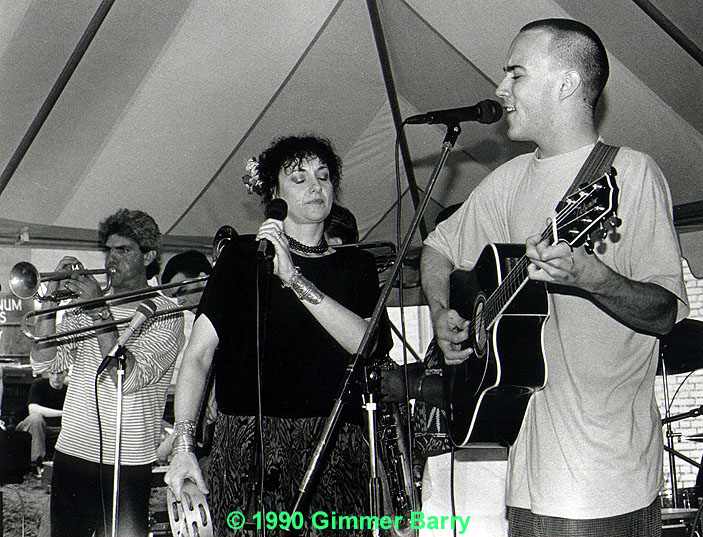
This picture shows Dave Matthews in an early stage appearance with the group Cosmology, playing a benefit for the local Tandem School. Dave was raised a Quaker. By coincidence Tandem affiliated with the Society of Friends a few years later to become Tandem Friends School. Dave's first groups were collaborations with the noted jazz trumpeter John D'Earth and were named Chameleon and Cosmology. The Dave Matthews Band came after this Cosmology photo in May 1990. Cropped from the picture due to size were D'Earth and his late wife, singer Dawn Thompson. Dave's band has a charitable trust, the Bama Works. The trust and the musicians regularly make substantial gifts to the community. One Albemarle migrant of note was a New York socialite. Felicia Schiff Warburg was the scion of a great international banking house, and listed in the New York Social Register. She had two prominent husbands before coming here in 1976: 2nd wife of Robert Sarnoff, head of RCA and eldest son of David Sarnoff who created RCA/NBC, and the 3rd wife of Franklin D. Roosevelt Jr., eldest son of 4-time President FDR. The marriage that lasted was to Albemarle businessman John Rogan. Felicia re-kindled the Virginia wine industry developed by Jefferson and destroyed by prohibition. If her neighbors were sots they should at least drink Virginia wine. Felicia wrote "Doers and Dowagers" in 1973, interviews with 20 of the country's most prominent women with wealth. John Rogan co-developed the Barracks Road Shopping Center and the Thomas Jefferson Motor Inn, now the Federal Executive Institute. Notably he co-founded and owned the Boar's Head Inn now operated by UVa. A little-known story about the Inn turned up mysteriously. Can one believe this? Virginia wine? Noted art collector Joe Hirshhorn came to town to buy some David Breeden sculptures, stayed for a small, private wine tasting at the Boar's Head Inn, and died the next day. Really. We were at the next table. But that was 1981. Many local wines are better now. Some Virginia whites match the better French whites. The reds are improving. The skill of blending red wine takes generations. But Oh! La La our boasts and prices. Americans separate good wine from bad by price, so Virginia vintners spin a perception of quality through premium prices. Socialite Patricia (ex-Kluge) Moses carried this to the extreme. She began wine production by pricing her first effort at $495 a bottle. It was vin tres ordinaire that few bought, aside from Bill and Hillary Clinton for Chelsea's wedding. In 2010 this 900 acre estate and gold-plated winery went to foreclosure. At auction the cases of wine sold for a few bucks to hotels and restaurants. Everyone who wanted to had a chance to try it. And there will be more of it, but under a new name. Destiny turned to central casting and found the perfect buyer: America's national dunce Donald Trump. It's now Trump Winery and B&B. Perhaps someday a presidential library will be there. Praise the lord. Doing just that down the road was white robed Sri Swami Satchidananda and his Integral Yoga ashram. He gave the area an international mystic appeal to the poor rich with nothing to do. Celebs and non-celebs living a life they don't understand. They have it well but are unable to leave well enough alone. They built him  Yogaville-on-the-James The swami understood all, and smiled. Before he died in 2002 he observed of his Woodstock generation flock: "They are all searching for the necklace that's around their necks. Eventually they'll look in the mirror and see it." That theme was interestingly executed in this painting by localite Virginia Canfield in 1981, now hanging in my living room. Look for the necklace.
 When he needed R&R from the patients, the swami slipped away to work on an old Caddie, trying not to get the robe dirty. Back when there was a USSR and a nuclear hit list, we were slated for annihilation in WW III because of a US Army spy lab in town. Soviet President Mikhail Gorbachev ended that crap. In 1993 he confessed he was a great admirer of Thomas Jefferson and celebrated Jefferson's 250th birthday here. We Russians wept with joy that day. Maybe Gorby ended the cold war to protect Monticello? Before deciding this is the place to live, remember that Virginia is in the bible belt. In the local daily paper 50% of the obituaries commit to belief in a mythical after-life. The faithful have problems understanding cause and effect. But as Twain said, "You can't reason people out of something they weren't reasoned into." Virginia, at last count, has executed more people than any other state, even more than Texas. The Death Penalty Information Center in DC counted 1,389 executions here between 1608 and 2004. Not so many lately. Since 1976 Texas put to death 5 times more prisoners than our Old Dominion. Virginia has the most draconian anti gay laws in the country, newly passed. Our three branches of state government cause us to be ranked last in the nation for fairness to consumers and fairness to labor. It doesn't matter who controls the legislature: conservative Democrats for 100+ years or conservative Republicans now, both are anti-consumer, anti-labor. We are one of only two states that approved the grossly anti-consumer UCITA - the Uniform Computer Information Transactions Act that's so awful even a business-dominated Republican Congress decried it. It's UCITA that has allowed software licenses to go wildly, cruelly one-sided. It's so bad that other states passed laws to exempt their citizens from Virginia laws.
The Virginia State Bar is a poster boy for consumer indifference. Lawyers can go right on practicing no matter how they treat clients. In 2004 this record of one lawyer came to light: During that time the Virginia Bar saw no cause to punish him or alert the public. Only after he beat his brother with a baseball bat did the bar act. He won't be allowed to practice law until he's released from prison. Virginia has the oldest continuous legislature in the new world and acts like it. The common rule of legislative committees everywhere: "You will treat your chairman as a deity - or be ignored" began in this state long before Congress adopted it. This puts an interesting spin on the state's 1776 motto, Sic Semper Tyrannis - Thus Always to Tyrants. In our legislature, as in congress, "Sic" means "Reverence." There is an unofficial maxim Virginia taught other states. "No man's life or property are safe so long as the legislature is in session." Why? Same as with congress: influence peddling. Our law makers are 140 amateurs. We elect "citizen legislators" who sit in session only a couple of months a year. To do that they must have comfortable incomes where they can leave their offices for two months to serve in Richmond. They are investors, not people on a tight budget. In 2004 (it's far more now) lobbyists spent $13.6 million to influence those 140 people. That's almost 100,000 head turning dollars per member. The few Virginia legislators who aren't financially comfortable are the most dependent on lobbyists for their lifeblood campaign funds. The state's largest consumer group spends zero on lobbying. And how it shows. * Virginia has done away with usury limits on business and investment loans. Consumer loans have outrageously high interest caps that are out-lawed as loansharking in most states (and condemned in the Bible, if hypocrisy amuses you.) * Virginia lets service providers like hospitals require patients to waive the homestead exemption as a condition of getting medical care. Sickness or injury can mean you lose your home due to America's breathtakingly inflated hospital bills. * When such bills wipe you out and you take bankruptcy, Virginia limits your sheltered net worth to $5,000, one of the lowest in the country. That means if your possessions and the equity in your home total more than $5,000, you lose everything. $5,000. At the other extreme, in Florida and Texas you're allowed to shelter several million in net worth. Sane states are in between. Virginians chose heartlessness over sanity. In Virginia, no one can afford to be a populist, though some make a pretense of it as my old friend Henry Howell did. He ran on the slogan "Keep the big boys honest." The bitter truth about American democracy is that populists have no friends in the room when committee assignments are made, bills are voted on, or district lines are drawn. So they're ignorable in the chamber. The Supreme Court decision that corporate checkbooks can exercise unlimited power to help or harm politicians ("Citizens United") insures power to the powerful. The Roberts Court kept the big boys ahead of the game, lest the Internet upset the imbalance. The power of "Move-On" to tap the masses and raise money for Obama was a heads-up. As a bible belt state, Virginia culture is cursed with fundamentalists. Reactionaries Jerry Falwell and Pat Robertson were Virginia boys with enormous followings. Their acolytes exert power in Republican administrations where they are appointed to jobs like textbook approval for public schools, choosing publishers who undermine science and history. So of the 623 high schools in Virginia, 237, over one-third, are private schools choosing their own texts. The percentage is higher for elementary and middle schools. Biblical meanness abounds. In 2006 the State Senate refused to allow local governments to voluntarily supplement the salaries of underpaid public defenders. By law, localities may only supplement the salaries of prosecutors. How can the Senate tell localities what to do? Because Virginia is under the "Dillon Rule" which says local government can do nothing without specific permission from the state legislature. Some states empower local government control; Virginia reversed that to control the local governments. That control was born in the jim crow era to assure statewide uniform white supremacy. It's worth noting that the only jim crow laws that changed in Virginia were changed by the US Congress, the US Department of Justice, and the federal courts. None have been repealed or revised by the Virginia legislature or a Virginia state court. Virginia's Supreme Court under both the GOP and the Dems has never been other than a conservative rubber stamp. Which brings us to the People's Republic of Charlottesville, a different story. In 1982 Charlottesville made a startling decision to grow no larger than it was. It land-locked itself forever within its modest 10.846 mile limits by selling its power of annexation to the surrounding county. The sale is absolute and irreversible so long as the county shares its tax revenue with the city, which it does.
The writer, a consent technician then living in southern Albemarle, was hired to sell this Revenue Sharing plan to skeptical county voters who had to approve it. Facing an approval rating of only 23% in a January poll a few months before the vote, we formed SAFE (Stop Annexation Forever) and asked local artist Charles Peale to create  the Annexation Monster By voting day he was a familiar face and voters understood what was at stake. Revenue sharing meant immunity from annexation. It won by 63%, a landslide. As a result, between 1983 and 2014 the county paid the city $231,799,844. Projected for 2014-2015 is $16,931,333. 35 years and a total turnover in population later, Revenue Sharing is breeding discontent. The full picture is a long story whistle blown here. The truism that expenses rise to exceed income happened almost immediately. But more important, the city discovered the perils as well as the joys of no space to grow. On the plus side, the city postponed the rendezvous with destiny that uncontrolled reproduction will exact on us all. The city's population growth went to a trickle. Charlottesville had approx. 40,100 inhabitants in 1990 and 40,099 inhabitants in 2000. Since then it officially lost population through census finagling, but currently there's a growth boom in downtown apartments. In 2019 the population exceeds 43,000. The bulk of area growth, and it's been substantial, was in urban and rural areas outside the city. Albemarle County's population surged ahead of the city to approach 100,000. Cities in Virginia are totally independent of counties. Virginia is unique in that. No other state does this. Counties can't tax city residents; cities can't tax county residents. They stand or fall on their own. Without annexation, the only way now for Charlottesville to expand rather than stagnate or shrink is to crunch what is already here: fill-in the gaps and build higher. Due to post-integration white flight to the overwhelmingly white county, Charlottesville lost its economically balanced population. With no power to annex suburban middle class sub-divisions, the percentage of children in Charlottesville public schools eligible for free or reduced-price lunches soared and is well over 50%. By comparison, Albemarle County is under 20%. Our economic curve is skewed. Families familiar with the area who can afford a choice of city or county tend to choose the county, not without cause. City real estate taxes are higher than county taxes. For my home, being in the city costs an extra $2000 in tax which includes a $200 tax on the rain absorbed by my lawn. Thanks to growing property values, taxes have grown much faster than inflation since the turn of the century. Inflation averaged 2.5% a year while property taxes rose an average of 8.4%, a total tax rate increase of 58.81% in seven years. Wages rose approximately 4% in that period, Social Security almost nothing. Fixed income retirees without ample pensions are in jeopardy here. Then the Wall Street 5th column sabotaged the national economy and property values plummeted. Like every other local government, Charlottesville found itself with less real estate value to tax, and less income. In order to grow the tax base the city sold its last remaining downtown parking lots to developers, to the delight of Albemarle's zillion shopping malls. Malls offer convenient free parking while the city charges for its garages. But it works. Alert city management made a downtown pedestrian mall hugely successful. While part of a national trend, Charlottesville did it better. The city is using heads-up economic tools to fuel the downtown economy. New downtown hotels and apartment projects supply walk-up customers who needn't park. This is in spite of a policy of "heritage extremism." Old buildings cannot be replaced but must remain essentially as-is in appearance, and be maintained. It's far more than "historic preservation." As practiced here it goes beyond architectural or historic heritage. It worships obsolescence. The policy as defined in law makes sense but as we do it, it shows what happens when government is in the grip of cultural elitism. We get the tyranny of the dilettante. Which looks like this. Any structure built before the birth of the person talking about it is a historic landmark which must be preserved. It may not be torn down and replaced with a useful structure. No definable architectural or historic importance need be shown. The code requirement to justify preservation is self-fulfilling. Protection of obsolescence is the default. This applies to worthless, condemned, long abandoned hovels that are boarded up, rotting, and termite-infested; outmoded storefronts that discourage customers; even decrepit accessory sheds. They once demanded the preservation of an abandoned, rotting hen house of no importance because it was old and someone in power said it was "quaint." That was his word to prevent the creation of student housing in the heart of the university area desperate for housing and zoned for it. Georgia O'Keefe once lived nearby, so her name was brought in to confuse the issue. Plans for repair, maintenance, and even interior modernization of structures must be approved down to the smallest detail by a Board of Architectural Review (BAR) who will determine what will be done, and how, and [an example from the minutes of the Feb. 2002 meeting] whether the wood you have chosen for your Fellini's Restaurant door may or may not be painted, and what color, and which brand of paint. All aspects - except co$t to the owner or his property rights - are ragged on at length until all the egos are satisfied. Since the inception of the BAR, its appointments have gone to extremists and control freaks at the urging of cultural elitists. Not without cause, BAR is said to mean Building Architect Revenue. If the owner of a vacant, decrepit, useless hulk fails to weatherize it, the city can have it done and place a lien on the property. Much of the city that was built prior to 1930 was declared "historic" and the owners stripped of property rights. When one buys property within a control area, he does not get the bundle of rights that define property ownership elsewhere. Albemarle County has no such controls, preferring to encourage historic preservation through the incentive of real estate tax breaks. Outside of the ubiquitous urban commercial sprawl and housing tracts, Albemarle has been successful at preservation in the opinion of all but extremists. These draconian city controls are not for the purpose of making things attractive. Often they have the opposite result, preserving ugly, inconsequential buildings or entire blocks. Gutsy developers have been known to bulldoze worthless structures in the night, accepting fines and the wrath of city hall in order to erect vitally needed new buildings over the obstinacy of Luddites practicing pernicious preservation. The city is bounded by two small rivers and until yesterday, ignored them. They are all but invisible and there's no waterfront, aside from a footpath. The county has developed a recreation area on the river. That footpath was a fully adequate graveled nature trail until the city paved it. They took a nature trail and paved it. Then they painted a white line down the middle. Why? The newspaper quoted the jackass responsible: "It became apparent with bikes, walkers, and dogs off leash that we need to provide people with some direction to stay to the right." He cited "several incidents in which loose dogs toppled bikers." The white line is to tell unleashed dogs which side to stay on. One of the steps discussed in recent years was revoking the city charter and reverting to a town. It wasn't totally a bad idea. We elect folks to city council chosen by their attitude, not a record of management. In fact, a business background usually results in a failure to win party nomination. The city runs well because we use the city manager form, hiring professionals to run the place. The city maintains a Triple A bond rating. Just the same, there is talk of dumping that and going to the strong mayor system. "Replace the pro with Bozo." That was a plank in the 2009 GOP city council platform. Republicans are not meaningful participants in the People's Republic of Charlottesville. Aside from transportation the pros do ok. Transportation is in a class of its own. This is a hard city to move cars through, and anti-vehicle Luddites in and out of government want it that way. Charlottesville makes getting around intentionally difficult. Witness these gambits: * "The name without a road." A vitally-needed commuter parkway was on the drawing board for 38 years. It was stalled by one obstructionist city council after another, imposing new requirements when the old ones were met. The county finished building their part many years before the city finished in 2015. Obstacles? The city builds a matrix of random concrete abutments reaching into the street. Motorists strike them constantly. It was widely predicted this would cause accidents. It does. At night the concrete obstructions come up as a sudden surprise. On a rainy night they are invisible even when you know they're there. Within months the concrete was covered with rubber scraped from tires. The official response to complaints: "People will strike the curbs." One councilor revealed his mindset, telling the press: "The obstructions are designed to disturb drivers and be an inconvenience." Concrete obstructions block side streets, requiring fire engines and school buses to use the entire oncoming lane to swing a turn. The same is true of buses when they try to re-enter traffic after a stop. A preposterous debacle that happens when city staffers attend national seminars and share ideas. The official justification: "Pedestrians like it." * Throughout the city there are random 4-way stop signs every few blocks. The purpose is "traffic calming" and thousands of gallons of gasoline wasted. * Traffic lights may be timed to disrupt rather than smooth the flow. And there are plenty. For a time, when federal grant money arrived new lights propagated like bamboo after a spring rain. * If the car count at the busiest hour justifies a traffic light under federal uniform traffic control guidelines, that light will run 24 hours a day. The sensible option of blinking caution during low traffic hours is rejected.
* A short downtown cul de sac capable of holding three cars has a 28-second green light, while on the edge of town a choked up turning lane at a highly congested intersection has a 6-second green light that inevitably leaves cars stacked up waiting to turn. The folks in charge know. They want them that way. [After years, the 6-second light went to 10 in 2015. It needs 15.] * The county installed cameras to impose fines on people who think lights are there to improve traffic flow. Tip: under Virginia law, notices of fines delivered by mail are unenforcible and can be ignored. * There were plans to convert the busiest downtown intersection, one that actually works, into a traffic roundabout, a move estimated that at rush hour would triple the congestion and delays. They did put traffic circles in some residential areas, including bad examples. One is a classic how-not-to. It's an over-size traffic circle so big that a moving van can't negotiate the turn. No bus can. What was reasonable was something half the size. And they allow parking, so a transpo Luddite leaves something parked in the narrowest place day and night. Elsewhere in town parts of intersections are blocked off to allow barely room for 2 cars to pass. Trucks? Buses? Fire engines? Forget it. 21st century cronyism: city hall plays new-age favorites. After suffering decades of this insult to good management, Charlottesville built a $2 million system to coordinate the city's traffic lights. Not only coordinate them, micromanage them. How? Perhaps holding it green a few extra seconds to allow a bus to get through, keeping traffic flowing and the bus on schedule. If people in the control room pay attention and aren't distracted, this program will continue to correct some of our transportation deficiencies. Like this one. Not long ago I spent 18 minutes waiting at a traffic light while one emergency service vehicle came through, followed a few minutes after by other EMS vehicle, followed a few minutes after by a third EMS vehicle. Each of these reset the traffic light back to step one instead of resumption from where the interruption began. EMS traffic controlling devices do not have to default to starting over. They sell intelligent ones that turn the light green for the emergency vehicle, then return the light to where it was in the cycle to keep traffic flowing. But traffic flow is not the goal. Every government has its quirks. That's one of ours. Bicycle lanes abound. Bikers tell us, "Roads cause cars. If you build roads, cars come. If you build bicycle lanes, bicycles come." So they built bike lanes, but bicycles did not come. They didn't build roads but cars came anyway. Bike lanes are 99% unused at night, 100% unused in the snow, 99% unused in the rain, and around here little used in the sunshine. Biker response: escalate the war on cars. Can everyone, young and old, bike at all times day and night, in any weather? Is biking to work in business clothes, or biking to shop, an all-weather option? Can mother take her 3 kiddies on a bike and come back from the supermarket with 5 bags of groceries? No. Not even on a bus.
I'm no stranger to biking, having peddled several thousand miles on Schwinns and Raleighs when they were SOTA in a far more jammed part of the country than Charlottesville. I love bikers, some more than others. It turns out that new age cronyism is no better than traditional cronyism. Their hand is in our wallet to fund special interest, like bicycle theft. Bike theft around town is a leading crime and a huge annoyance they hoped to control with taxpayer bikes. The concept was simple and stupid. Our solons bought the concept that gangs of thieves will stop stealing expensive bikes from private owners and selling them for big money if they can legally take worthless free bikes. Got that? So we got the "borrow bike" program which placed yellow public-use bikes downtown and at the university. Alas, the needy fellow steals a yellow and within three weeks every yellow bike disappeared or was vandalized. Supporters hailed that as a great success. "You can't steal borrow bikes because no one owns them," they explained in their appeal for tax funds to buy more bikes. Please let it be the drugs. * Changes from the top down are almost assured to happen. From the bottom up change is another matter. If a resident needs to call attention to a neighborhood problem, he's supposed to work through layers of red tape involving Neighborhood Associations before the problem can be heard. The red tape came to us in 2000 after 240 years of small town government accessibility. "Cities are doing this now," we're told when staff and councillors come back from collegial city management conventions where the mantra is "Professionals don't listen, they tell." * To begin the new millennium city council proposed doubling the fee for overtime parking, citing an outsider's study recommending it. They always hire outsiders when they propose something like that. No one who lives here would suggest it. Merchants were united in begging them not to, explaining, as the same study showed, that downtown lacked parking for shoppers. A month later when a vote to increase the overtime parking fee came up, council abandoned plans to double the fee and instead tripled it. The biking councilman who pushed that through suggested shoppers should park a quarter mile from downtown in the city's highest crime neighborhood where personal safety is at risk from gangs, a taboo subject.

These are concepts for big, sprawling cities, not us. They are means to create "affordable housing" which capitalism (the church of greed) doesn't provide. "New urbanism" is jargon for something nasty: knocking down housing values by removing the amenities that make them desirable. "Connectivity" is one weapon. Change a one-entrance subdivision to multiple entrances, converting quiet, low traffic, residential streets into shortcuts for through traffic. "Calmed" traffic, to be sure, with obstructions to plague drivers and block service vehicles. Specifically, the plan called for access to the local interstate highway through one of the city's quietest one entrance subdivisions, bringing down property values. That subdivision included a city councilor's home. The proposal died, and Johnson Village retained its residential amenity. Hizzoner The Mayor helped the idea along. That particular mayor is retired now but he was a sketch. When in office, he led groups of bicycle riders down Main Street at rush hour to block traffic, in what he called a "show of civic camaraderie." (His term.) The Democratic Party, my party, has totally dominated local government since the late 1960s, and deserves to. There was a surprise in 2002 when a personable Republican with a ponytail pulled more votes than a Democrat in a council race. That seldom happens but the Dems ran an outspoken preservation extremist and she lost. The Republican served one deplorable term. Republican leadership here is embarrassing. Not long ago their two council candidates were a convicted felon and a newcomer to the city. Nice people, but unorthodox backgrounds are not a qualification. It came back and bit them when in 2013 they ran two candidates with excellent qualifications who were swamped anyway. I voted for them because I believe 2-party, 3-party, 4-party government is better than 1-party, so long as mine has the majority. Charlottesville is one of Virginia's two liberal Democratic Party cloisters. For that reason, for longer than anyone remembers Charlottesville and Albemarle have been gerrymandered into Republican congressional districts to destroy our influence. We rule Charlottesville but our tail wags no dog. In a bizarre upset, in 2008 when Obama won the Presidency our district did put a Dem in congress. His vote was credited with passing Obamacare and he was booted out after one term. Obama came to town to campaign for him. Presidents always come to Mr. Jefferson's village, even Republicans like Teddy Roosevelt and Bush the First who held his Education Summit at UVa. It's tradition. Gerald Ford came, and Jimmy Carter. Lyndon Johnson had his first heart attack here visiting family, and our rescue squad got a first-rate cardiac unit out of that. FDR secretly weekended at an Albemarle estate, Kenwood, for years; William Jefferson Clinton began his inauguration trip to the White House from Monticello. And of course Dumbo has a winery here. Losers campaigned here also. William Jennings Bryan's outlandish ideas mesmerized Southerners. Alabama segregationist George Wallace campaigned here to succeed John F. Kennedy, hoping, as I wrote in my newspaper column, that "the country would turn from the vineyard to the barnyard." If voters tire of things we might see change. * Despite this being home to the state university and its School of Education, our city public schools barely reach state averages in a state where most schools don't reach national averages. Across the country, Virginia ranks poorly in public education. The HS graduation rate in our capitol city is beyond deplorable. Poor local performance of our schools is not for lack of money. We tripled per-pupil expenditures since the early 90s with marginal performance improvement. Charlottesville now has one of the highest per-pupil costs in Virginia. According to the daily paper a few years ago, for black students, out of 132 school divisions in the state Charlottesville ranks #129 in English and math. That's 3rd from the bottom. In science, says the paper, city black students ranked last in the state, #132. Nationwide, black scholarship performance measures about 50% lower than white performance, with hispanic slightly above black. Charlottesville public school's racial unbalance makes that acute here. Every school board candidate (they are elected, not appointed) and every council candidate lists "closing the gap" in public education as a top priority, yet cannot do it. Some say it's because we have excellent, well-attended, private schools where there are no gaps. * We have the usual utility taxes every city does, plus a whopping 15% tax on TV cable, alas Comcast. Half that is named "Utility Tax" and half is named "Franchise Fee." You pay them both; they are on your bill. Regressive taxes are inviolate despite large budget surpluses nearly every year. * Budget surpluses are to spend. City Council once actually appealed for public suggestions how to squander a half-million dollar surplus.
 This was their response to the suggestion not to. The 2006 surplus was serious money, a whopping $9.9 million. Then a year later the surplus was $6.7 million. Since 2000 we've been stripped of more than $20 million in taxes not required for the budget. Despite such surpluses, whenever there was an area-wide power outage we lost our water supply because the pumps had no back-up generators. After a change in leadership they got them. Stand-by power is amazingly cheap but government had more important concerns. Who can forget that City Hall once spent $20,000 to bring a Christmas tree from California. The city's Revenue Sharing agreement with Albemarle rests on the tax burden each side blesses on its citizens. Charlottesville always taxes more so as to stay on the receiving side and not the giving. That creates an imperative for the city to over-tax. We blacktop nature trails and paint white lines on them because we can afford to. * Money is wasted here in piles. Whether due to empire building or whatever, taxes fund two separate governing arms, one for the city manager and another for city council. As the mayor put it in 2018, "We're now going to have real staff. We'll have a chief of staff and three people under them. ... It will enable us to create a parallel government to the city manager." Under the city manager is also a 2nd planning staff, yet every potential action requires costly outside consultants with often less expertise than is found on staff or at the local university. No local official wants his name on a proposal that might prove unpopular. There are names for these things. The Interloper Effect is the power of third party consultants to be taken as objective and without motive. Of course that's because the public doesn't know what biases consultants have. That's for the insiders who choose them to know. Then there's Consultation Paradox, the belief that solutions proposed by people on your staff are less likely to receive support than those from paid outsiders. * Frugality? The word is met with haughty derision. It bruises local pride. We spend with the big boys. We're well-balanced: the obligation to over-tax carries an obligation to over-spend. That helps the key constitutional offices - Treasurer, Commissioner of Revenue - to be honest and professional. This is not your grandparent's South. Good ole boy secrets. * For decades the community was charged inflated monopoly prices for concrete products. Cinderblock and concrete delivered to construction sites was more expensive in Charlottesville than elsewhere. The monopoly made one family hugely wealthy. * Due to greed and copy-cat pricing, motor fuel and heating oil used to cost more in Charlottesville than elsewhere. This doesn't happen in other isolated Virginia cities like Lynchburg or Waynesboro where price gouging could go on as easily, but doesn't. It was a Charlottesville custom. * Living costs rank among the highest in Virginia but wages do not. * Despite the area having one of the lowest unemployment rates in the nation, you're out of luck if you're over 60 just like in the rest of the US. Age discrimination for good jobs is near-total. No one wants older workers, as local writer Barbara Ehrenreich learned doing research for her book on employment, "Bait and Switch: The (Futile) Pursuit of the American Dream." That's with us forever due to health insurance costs. If you're over 60 and need income, start a business, drive a cab, or learn to use ebay. * Low wages mean truly competent builders, electricians, plumbers, etc. are scarce. Many good technicians commute two hours away to prosperous Northern Virginia for double the income. * In addition to uneven workmanship there are colossal blunders. For example in 2001 workers in a neighboring community, Lake Monticello, actually crossed-connected the community water and sewer systems.
Aside from some common electronics, a Best Buy "Geek Squad," and Sears, there is no authorized warranty repair facility for a consumer product within 40 miles. A USA Today report was no surprise when it showed Charlottesville tied for 3rd in having the most catalog-loving shoppers in the entire world. The only cities ahead of us were Juneau and Fairbanks in Alaska. (Charlottesville tied Anchorage.) Much of that has since shifted to on-line shopping. We pay more for water and sewer than almost anywhere in Virginia and have regular increases. We have financially strong state-of-the-art Internet providers. High tech thrives here, with a massive local infrastructure. We have more than a fair share of dot.com successes and one stupendous failure, Value America. Our monopoly land-line telephone company (currently Sprint) changes hands every few years, and like every all-copper telco, talks maintenance and improvement but they are all hat, no cattle. As everywhere else, we have numerous cell phone companies. The challenge is to find the least bad deal. Every community is made up of people who make things happen, people who watch things happen, and people bewildered by what happened. We have publications to serve them all. The local Daily Progress was founded in 1892. It passed out of local ownership in 1971. In 2012 it was bought by Berkshire Hathaway, Warren Buffet's group. The future has potential. The Progress blazed a new trail by joining forces with a local news-gathering group, Charlottesville Tomorrow, that covers and reports local government meetings. Beat coverage had been declining, and is now stabilized and improved. This successful partnership received national attention in Columbia Journalism Review and elsewhere. Virginia's flagship paper, then and now, is the Richmond Times-Dispatch, a southern institution available for home delivery, as is the Washington Post. There are more than a dozen monthlies and weeklies published in Charlottesville, mostly throwaways wasting advertiser money. The oldest weekly, C-ville, has what we expect to find in the leading alternative weekly: advocacy journalism, biased reporting, lack of balance, often good writing. C-ville covers local issues that often get superficial treatment or none in the daily or elsewhere. Saloon society and decaf society are well-covered. The weekly serves as a community diary reflecting not what's good, but what's in. We have a scary number of restaurants and coffee shops, approaching 500, but not one European deli. They open and fail. So supermarkets and bars have deli sections, some quite good. Talented coffee roasters are sprinkled around. Barbecue is everywhere, good and awful. Pizza can be a treat, even if you know the best from the ordinary. Mexican and Chinese food abound and Chinese delivers. There's plenty of Sushi, two genuine French restaurants and a French cafe, but only one restaurant, the Aberdeen Barn, brings in high quality beef from the midwest. Two markets have aged beef in hanging lockers. Costco sells USDA Prime as well as Choice, but most chain supermarkets promote their own in-house grade ("Angus" "Rancher") that falls below USDA Choice. There's a large number of new book stores and used book stores, possibly the highest number per capita in the South. In mid-2006 craigslist opened a full-featured Charlottesville site at http://charlottesville.craigslist.org/ . There are 30 radio stations that claim we are in their primary or secondary coverage area. One ownership group shares a local news department. The large number of stations formerly owned by Clear Channel were sold for half their cost, a glimpse of how little radio matters today. Our eight AM stations are devoted to airhead chatter and preach-for-the-gold. Most of the 22 FM stations are juke boxes for the help. Non-commercial radio is a better story. The University has WTJU-FM devoted to locally produced jazz, pop, classical, rock, and niche programming that's often amazing. Disclaimer: I helped put that station on the air in the 1950s and was its first chief announcer (so-called.) At least three places on the dial bring in National Public Radio (NPR) and another carries programming from Public Radio International (PRI.) Back when these stations played classical music all day, NPR told us this area had the nation's highest per capita NPR listenership. Since then much of the music has been replaced by talk so that's probably no longer accurate. The city has four network TV stations. NBC (here) and PBS (by repeater) had the area to themselves for half a century. Then in 2005 CBS and ABC came in. This year NBC, CBS, and ABC are getting new owners. Fox was available from Richmond and locally by repeater. All networks are available over the air for free. There are also undisclosed HDTV broadcasts you will discover if you have a roof antenna. Mine gets 31 off-the-air channels. No one in town installs roof antennas; you have to do it yourself. Like every small TV station in the country, ours can't afford to go overboard covering news. To fill the time, the weather is presented in excruciating, repetitive detail in every 30-minute news broadcast after a weather summary at the beginning, to be followed by another at the end. All stations and newspapers have an Internet site offering news. Only one stands out, WVIR-TV. Not much depth but twice as many local stories as anyone else, and it's not pay-walled. DirectTV and DishNet satellites are at an elevation of around 23 degrees, not ideal in hilly terrain but available to nearly everyone. Cloud cover interferes about 6 to 10 hours a month. There are two multiplex movie theaters here. They are very loud, very cold. And there's a summertime drive-in about 30 miles away. Another trip is the IMAX theatre 90 minutes away at the Science Museum of Virginia in Richmond. Charlottesville's upper middle school and high school have a higher percentage of students participating in serious music programs than almost anywhere in the land, and they win gold medals. The emphasis on excellence in music is a tradition here. Through the University's various concert programs the leading world-class musicians play here, often when on their way up. The amount of live theatre and awesome talent is staggering and often amazing. Not infrequently the best scripts of the year are locally written. Seldom is there a weekend without two or three live theatre productions to choose from. Live entertainment audience is so broad that a 1930s Paramount movie palace in the heart of downtown was restored from the foundation to the dome to become a non-profit performing arts center. In 2004 Tony Bennett did the dedication concert. A few blocks away is another performing arts center. It is adjacent to a third performing arts center. Those are distinct from the downtown mall amphitheater two blocks away where headliner acts play for "Fridays After Five," a weekly summer community block party. None of these is named "Performing Arts Center." That name was reserved for a fourth one at the city's public high school. The university is down to three concert venues after spectacularly dynamiting the 4th one in 2019. Only the UVa football stadium has the capacity (60,435) for immensely popular attractions like Dave Matthews and U2. The new John Paul Jones arena (named for a donor) can hold 16,000 and won a national award for the best new US concert venue to open in 2006. Don't expect ticket bargains; you are what you charge. While these theaters are available for anything requiring a stage, the area also has a half-dozen community theaters for adults and children, and our public and private schools regularly put on plays including musicals. Visual art has several downtown galleries and a gallery at UVa. Richmond's Virginia Art Museum an hour away has a spectacular collection of modern and impressionist art and Faberge eggs, and hosts major international exhibits. The public library exceeds what we expect. Its excellent, well-organized web site https://jmrl.org can be googled into 8 languages at the push of a button. Sculpture has always had a special role here. The community indulged in outstanding over-size equestrian statues eons ago and has an enviable collection, recently controversial. In this era, Biscuit Run Studios was the world center for modern creations in soapstone and has subordinate studios for other media. The local program "Art in Place" spreads modern sculptures, mostly metal, throughout the community. Winners of a national annual competition place their statuary on highway medians, at the roadside edge of parks, and other visible areas for several months. Occasionally the city buys one for our permanent outdoor collection. In my neighborhood we had
 Thomas Givens' Whale Tail, a permanent exhibit that was destroyed by two huge snowfalls followed by a microblast windstorm. In its place, Givens provided this, visible from my home.
With such wide exposure, "What the hell is that?" gives way to endearing familiarity. With substantial resources committed to flowers, shrubs, and trees along the roadsides, maintaining refinement is not a losing battle here. It's not even hard. Some who are fed up with our declining world find Charlottesville lets them forget the US isn't what it was, and never has been.

Music, theatre, art, and a colorful downtown mall temper one's exasperation. An island for romantics. |


| The name Freeware Hall of Fame is
Service Marked by
Rey Barry (rey at cstone.net) All rights reserved |

|